Author Archives: dfwwea5

***WINTER STORM UPDATE***

Major to Severe Impacts Expected

A major winter storm will affect North Texas beginning Friday evening and continuing through the weekend. A mix of wintry precipitation will create hazardous travel conditions, followed by severely cold temperatures that will keep roads dangerous well into next week.

General Timeline

  • Friday Evening:
    Precipitation may begin early Friday as drizzle/rain. Arctic front arrives late morning. Temperatures will be falling in the afternoon, and freezing rain or sleet could begin as early as 6pm, especially north and west of DFW.
  • Late Friday Night through Saturday Morning:
    Freezing precipitation becomes increasingly widespread.
    By midnight, confidence is high that much of the region is seeing sleet and freezing rain. Precipitation could be moderate to heavy at times. Roads will deteriorate rapidly.
  • Saturday:
    Periods of moderate to heavy sleet continue through Saturday morning. There will be a relative lull in precipitation Saturday afternoon awaiting the next more potent wave.
  • Saturday Night into Early Sunday:
    Precipitation will be the heaviest during this final round and most significant. Sleet will also be mixing with snow and changing over to all snow by Sunday morning before tapering off.
  • Sunday Morning:
    All precipitation ends by midday Sunday.
  • Sunday Afternoon:
    No additional accumulation is expected after this point, but impacts will continue to worsen due to the cold.

Expected Accumulations

  • Freezing Rain: 0.10–0.25 inches
    A light glaze is possible from early onset rain that freezes and freezing rain (rain falling after freezing at the surface). This will be mixed with and change over to sleet with time as the vertical column cools.
  • Sleet: 2–5 inches
    This will be the primary impact and precipitation form. Sleet compacts into a dense, icy layer that is extremely difficult to melt and will create long‑lasting travel hazards.
  • Snow: 1–3 inches
    Most of this falls Saturday evening as snow begins mixing with sleet and changes over to all snow as the vertical column cools further.

Be advised these precipitation amounts could change based on how the warm nose above the surface evolves and where any convective banding sets up.

Severely Cold Temperatures

  • Low Monday Morning: Near 6°F at DFW Airport, colder possible in the normally colder spots and where the biggest ice/sleet/snow totals occur. There is a non-zero chance that DFW Airport could fall below 5°F.
  • Wind Chills: As cold as 10 below zero
    These temperatures are dangerous for anyone without adequate shelter and may cause issues for exposed pipes and infrastructure.

Road Conditions

  • No meaningful improvement is expected until Tuesday.
    Temperatures are unlikely to rise above freezing until then, and even Tuesday’s thaw will be limited.
  • Refreeze likely Wednesday morning.
    Any melting Tuesday afternoon will freeze again overnight as temperatures drop back into the teens and 20s.

Looking Ahead

Another Arctic front may move across the area late next week, reinforcing the cold pattern.

It is advised not to travel this weekend unless it is an emergency. Be advised the bridges and overpasses will be the first to freeze.

***WINTER STORM UPDATE***

Winter Storm Update – Major to Severe Impacts Expected

Issued: Thursday Morning

A high‑impact winter storm is set to affect North Texas beginning Friday afternoon and continuing through the weekend. Confidence has increased significantly overnight, especially regarding the amount of moisture available and the severity of the cold air that follows. This update reflects both my original forecast and the latest guidance from the National Weather Service (FWD) and ensemble model trends.


Key Points

  • Arctic front now expected Friday afternoon, later than earlier projections.
  • Confidence is high in a very wet storm, with around 2 inches of liquid equivalent likely.
  • Significant sleet accumulation remains the most likely outcome, with snow on the back side.
  • Dangerous, prolonged cold will follow, with single‑digit lows increasingly likely.
  • Residents should complete all preparations today and early Friday at the latest.

Expected Accumulations (My Original Forecast – Still Valid)

  • Sleet: 2–5 inches
  • Snow: 1–3 inches on the back side as the column fully cools
  • Freezing Rain: 0.10–0.25 inches, locally up to 0.30–0.40 inches in the worst corridor

These ranges remain the most physically consistent with the latest data. FWD’s forecast is now closely aligned with this structure, and ensemble guidance strongly supports a sleet‑heavy event with accumulating snow late.


Moisture Confidence Has Increased

Overnight ensemble trends from multiple model systems (GEFS, CMC, ECMWF) show a strong, consistent signal for high moisture, with many members producing 1.75–2.50 inches of liquid. This is a notable increase in confidence compared to earlier in the week.

This means the ceiling for frozen accumulation is higher than before, and the upper half of my ranges is now more likely than the lower half.


The Cold: Severe, Prolonged, and Dangerous

This is not a typical cold snap. Ensemble guidance is nearly unanimous:

  • Single‑digit lows are now the most likely outcome for much of North Texas.
  • Many members show temperatures below 5°F, with a few dipping below zero.
  • Sub‑freezing temperatures may last 72 to 100 hours, with wind chills well below zero.

The broader guidance suite overwhelmingly supports a severe Arctic outbreak.


Timing

  • Friday Afternoon: Arctic front arrives. Temperatures fall rapidly.
  • Friday Afternoon: Precipitation begins, likely as rain, then freezing rain transitioning to sleet Friday evening.
  • Friday Night – Saturday: Long duration of sleet, gradually mixing with and changing to snow.
  • Saturday Night – Sunday: Snow tapers off; bitter cold settles in.
  • Sunday – Early Next Week: Hard freeze continues.

Preparation Message

Residents should complete all preparations today and early Friday morning at the absolute latest.

This includes:

  • Protecting pipes (interior and exterior)
  • Ensuring pets and livestock have shelter
  • Stocking essentials (food, medications, batteries)
  • Preparing for hazardous travel from Friday night through the weekend
  • Checking on vulnerable neighbors or family members

Once the front arrives Friday afternoon, conditions will deteriorate quickly and temperatures will plunge.


Bottom Line

A major winter storm is expected across North Texas with significant sleet, accumulating snow, and dangerous, severe, prolonged Arctic cold. Moisture confidence is higher than ever, and the later arrival of the front does not reduce impacts—it simply shifts the timeline slightly. The Winter Storm Watch will likely be upgraded to a Winter Storm Warning.

Finish preparations today.
Friday afternoon begins the transition from normal to hazardous.
Friday night through Saturday will be the core of the storm.

***WINTER STORM UPDATE***

Winter Storm Update: A SEVERE Winter Storm, Multi‑Day Event Is Taking Shape

North Texas is now staring down a SEVERE winter storm that will bring significant frozen precipitation and a prolonged period of subfreezing temperatures. This combination can create major disruptions to travel, daily life, and infrastructure. Preparation over the next 24–48 is essential. Be prepare to alter your weekend plans, and also be thinking about early next week plan changes as impacts will linger into next week.


Why Urgency Is Warranted

This event is not a quick hit of wintry weather. We are expecting:

  • A long-duration period of sleet, freezing rain, and eventually snow
  • Temperatures falling below freezing this weekend and staying there for 72–100+ hours
  • Single-digit lows early next week
  • Very limited melting until at least Wednesday

This is the type of setup that can cause frozen pipes, difficult or impossible travel, and strain on infrastructure. The cold is deep, the moisture is plentiful, and the pattern supports impacts that last well beyond when the precipitation ends.


What You Should Do Now

1. Winterize Your Home

Temperatures this cold can cause problems even in well‑built homes. Steps to take:

  • Insulate or wrap exposed outdoor pipes
  • Cover outdoor faucets
  • Open cabinets under sinks to allow warm air circulation
  • Let faucets drip in vulnerable areas
  • Know how to shut off your water in case of a burst
  • Bring pets and plants inside
  • Check space heaters for safety and proper operation

These steps are simple but can prevent expensive damage.

2. Shop and Prepare for Several Days of Limited Travel

With sleet and snow expected to accumulate and temperatures staying below freezing for days, roads may remain hazardous well into next week. Consider picking up:

  • Groceries for 3–4 days
  • Medications
  • Pet supplies
  • Batteries and flashlights
  • Fuel for vehicles and generators (if you have one)

Even if major highways improve, many neighborhood roads may stay icy.


How Long Will We Be Below Freezing?

Based on current guidance:

  • Below freezing from Friday through at least Tuesday, possibly into Wednesday
  • Single-digit lows likely Sunday, Monday, and Tuesday mornings
  • Some outlying areas may approach zero (actual temp not wind chill)

This is a multi-day hard freeze, not a brief cold snap. That’s why winterizing is so important.


Realistic Accumulation Expectations

There is still some uncertainty in the exact mix of sleet, freezing rain, and snow, but the overall picture is becoming clearer:

  • Sleet is likely to be the dominant precipitation type early
  • Some freezing rain is possible, especially at the start
  • A transition to snow is increasingly likely late Saturday into Saturday night

Given the moisture available, a combination of several inches of sleet and additional snow on top is a realistic expectation. Even modest freezing rain amounts could add stress to trees and power lines.

This is enough to cause multi-day travel problems, especially with temperatures staying below freezing.


Bottom Line

This is shaping up to be a SEVERE winter storm for North Texas. The combination of significant frozen precipitation and a prolonged hard freeze means preparation is essential.

If you take steps now—winterizing your home, stocking up on essentials, and planning for limited travel—you’ll be in a much better position once the storm arrives.

***MAJOR WINTER STORM UPDATE FOR DFW***

Winter Storm Update — Tuesday Morning

The latest overnight data continues to sharpen the picture for this upcoming winter storm, and the overall signal has strengthened in several key areas: earlier transition to frozen precipitation, higher confidence in significant sleet and snow, and a growing likelihood of extreme cold behind the system. We can now say with confidence this is looking to be a Major Winter Storm.

Arctic Front & Temperature Trends

All major global models — ECMWF, GFS, CMC, and UKMET — now agree on a deep, dense Arctic airmass pushing into North Texas late this week. The exact arrival time of the front will become clearer once the NAM comes into range, but the trend continues to favor an earlier arrival than previously advertised.

Ensemble guidance has shifted colder:

  • GFS ensemble
  • CMC ensemble
  • UKMET
  • ECMWF ensemble

A realistic forecast at this range is a low near 10–13°F Sunday morning, with a strong pathway to single digits if we have significant sleet/snow cover.

QPF & Precipitation Type

Confidence is now very high that this will be a high‑end moisture event, with 2–3 inches of liquid‑equivalent showing up across all major guidance suites.

The key question remains precipitation type — but the trend is toward a frozen‑dominant event for the DFW area:

  • Freezing rain: Possible in brief windows, but not the primary hazard.
  • Sleet: Increasingly likely to be a major component with significant accumulations likely.
  • Snow: Growing support for significant accumulations.

A combination of significant wintry precipitation is now a credible and physically consistent outcome. This will likely be very disruptive to travel this weekend, if not making travel impossible. We cannot predict with confidence yet exact amounts as we don’t know predominate precipitation type and phase change over yet. This will become clearer as we get in better range of the higher resolution guidance.

Pattern Recognition: A Classic NTX Winter Storm Setup

The upper‑air pattern is one of the historically reliable setups for major winter storms in North Texas:

  • A deep western U.S. trough
  • A strong Alaska ridge feeding Arctic air southward
  • A Baja upper low ejecting into Texas
  • A loaded southern jet
  • A dense Arctic dome already in place

This is one of the classic H5 regimes that has produced many of the region’s most significant ice and snow events.

What’s Changed Since Yesterday

  • Confidence in single‑digit lows has increased.
  • Confidence in a frozen‑dominant event has increased.
  • Confidence in 2–3 inches of QPF is now very high.
  • The warm‑nose‑driven freezing rain scenario is becoming less favored.
  • The high‑end scenario (heavy sleet + significant snow + severe cold) remains on the table.

What to Do?

Residents of North Texas should prepare now for a high-impact major winter storm and potential of severe cold this weekend. Make sure you have winterized your homes (wrapping outdoor pipes and faucets).

MAJOR ARCTIC SURGE WITH POTENTIAL OF SIGNIFICANT WINTER STORM THIS COMING WEEKEND FOR DFW

A Major Pattern Shift Brings Strong Arctic Air to North Texas This Weekend

Confidence has increased significantly over the past 48 hours that a strong Arctic airmass will surge into North Texas late this week, bringing the coldest temperatures of the season and the potential for a significant winter storm. While important details are still being refined, the overall pattern is now well‑established across all major global models and their ensemble systems.

Teleconnections and the Large‑Scale Pattern Support a Significant Cold Outbreak

This event has been telegraphed for several days by the broader hemispheric pattern. Multiple teleconnection indices have aligned in a way that historically favors strong cold outbreaks in Texas:

  • Negative AO opening the Arctic gate
  • Negative EPO/WPO building a cold reservoir over Alaska and western Canada
  • Positive PNA supporting a western ridge and downstream troughing
  • MJO in phases 7–8, a cold‑favoring configuration for North America

In addition, the polar vortex has been displaced southward, with a lobe dropping toward Hudson Bay. This displacement enhances high‑latitude blocking and promotes southward transport of dense Arctic air.

At 500 mb, guidance shows a high‑amplitude ridge over Alaska and a broad trough digging into the central U.S. — a textbook setup for delivering Arctic air deep into Texas.

Arctic Air Is a High‑Confidence Outcome

Multiple ensemble systems now show a strong cold cluster for this weekend:

  • Canadian and GEFS ensemble means
  • ECMWF ensemble mean
  • ECMWF deterministic
  • ECMWF control
  • UKMET deterministic

When both the deterministic and control runs of the ECMWF are in the teens, and the Canadian/GEFS means are even colder, it strongly suggests the ensemble mean is too warm.

Bottom line: Teens are a reasonable baseline for much of North Texas this weekend, with single digits not off the table, especially if we get snow/ice.

A Non‑Zero Threat of Severe Cold

In North Texas, severe cold is typically defined as temperatures of 10°F or lower, which is the threshold at which the National Weather Service may issue an Extreme Cold Warning.

Given:

  • The strength of the incoming Arctic airmass
  • The cold clustering across all ensemble systems
  • Deterministic guidance already in the 10–15°F range
  • The potential for ice or sleet cover enhancing radiational cooling

There is a credible, though not guaranteed, threat of severe cold in parts of North Texas this weekend. This risk is highest in rural and low‑lying areas north and west of the Metroplex, especially if skies clear Saturday night into Sunday morning.

This is not a forecast of single digits — but the pattern strongly supports the possibility, and it deserves to be monitored closely, particularly if we get snow/ice.

Wintry Precipitation: Not Guaranteed, But Credibly on the Table

A disturbance near the Baja region is expected to move eastward, providing lift and moisture over the shallow Arctic dome. This is the classic overrunning setup that has produced past ice and sleet events in North Texas.

At this range, confidence in exact amounts or precipitation type is still limited. However, the pattern strongly supports at least the possibility of freezing rain or sleet somewhere in the region from Friday into the weekend with the potential for significant accumulations.

Even light ice or sleet accumulation would increase the likelihood of very cold temperatures afterward, as surface ice cover enhances radiational cooling.

Final Thoughts

The signal for a strong Arctic intrusion is now clear and well‑supported by both the teleconnections and the model guidance. The wintry precipitation threat is credible and deserves close monitoring, and there is also a non‑zero threat of severe cold if the cold dome deepens and surface conditions favor radiational cooling. Expect continued refinement as we get closer to the weekend.

HIDDEN SUBZERO TEMPS: RECONSTRUCTING DFW’s COLDEST TEMPS AND THE AMO CONNECTION

When we talk about Dallas/Fort Worth’s coldest mornings, the official record low of −8°F in February 1899 usually takes center stage. But the thermometer record only began in 1898. That means some of the most brutal Arctic outbreaks in Texas history — the ones that froze the Mississippi River at New Orleans — happened before we had instruments in place to capture them. By piecing together proxy evidence and ocean cycle timing, we can reconstruct a hidden history of subzero mornings in North Texas.

The AMO Cycle and Cold Outbreaks

The Atlantic Multidecadal Oscillation (AMO) is a natural climate variability pattern characterized by long-duration changes in the sea surface temperature of the North Atlantic Ocean. The AMO flips between warm and cold phases every 25–40 years. These transitions often coincide with instability in jet stream patterns, opening the door for Arctic air to plunge south. United States winters are colder during the cold phase of the AMO.

  • Warm AMO: Fewer outbreaks, but sharp extremes still possible (1989, 2021).
  • Cold AMO: More frequent and deeper outbreaks (1835, 1887, 1899).
  • Phase flips: The most punishing cold often clusters right before or during a transition.

Mississippi River Freezes at New Orleans

Freezing the Mississippi at New Orleans is the ultimate proxy signal. It means the Arctic dome was so deep that even the Gulf Coast was locked below freezing for days. The last time the Mississippi River froze at New Orleans was in February of 1899, and DFW’s temperature reached -8°F. So if the cold was severe enough to freeze the Mississippi River at New Orleans, then we can reasonably project that the temperature in DFW was at least -5°F to -8°F, but likely colder than -8°F, especially the earlier you go back given the “Little Ice Age” effect on temperatures.

  • January 1785: Post‑Laki eruption winter. Mississippi froze, implying DFW likely hit −8°F or colder.
  • January 1816: Tambora eruption, “Year Without a Summer.” Gulf freezes suggest another subzero event in DFW.
  • January 1835: The “Cold Friday” outbreak destroyed citrus groves and froze the Mississippi. DFW likely plunged to −8°F to −12°F.
  • January 1887: The “Great Die‑Up” winter. Ranchers reported weeks of continuous freezing weather. Mississippi froze again, pointing to subzero in DFW.
  • February 1899: The benchmark. New Orleans hit 3°F, Galveston 0°F, and Dallas officially recorded −8°F.

Reconstructed + Documented Subzero Timeline for DFW

Here’s the likely history of DFW’s coldest mornings, reconstructed before records and documented after 1899, aligned with AMO phasing:

The Pattern

YearEventMississippi RiverDFW MinimumAMO Context
1785Post‑Laki EruptionFroze at New Orleans−10°F to −12°F (reconstructed)Transition to cool phase
1816Tambora EruptionFroze at New Orleans−10°F or colder (reconstructed)Transition to cool phase
1835Cold Friday OutbreakFroze at New Orleans−10°F to −12°F (reconstructed)Transition toward warm phase
1857*Severe Arctic OutbreakAnecdotal Gulf Freezes (Not reliable)Possible subzero cold in DFW (reconstructed)Cold AMO Phase flipping to Warm
1864*Civil War OutbreakMany reports of Frozen RiversPossible subzero cold in DFW (reconstructed)Warm Phase AMO
1887Great Die‑Up WinterFroze at New Orleans−8°F to −10°F (reconstructed)End of warm phase, volcanic forcing
1899Great Arctic OutbreakFroze at New Orleans−8°F (official record)Flip into cool phase
1930Jan Arctic OutbreakNo freeze-1°F at DFWTransition toward warm phase
1949Jan Arctic OutbreakNo freeze-2°F at DFWEnd of warm phase, flip to cool
1989Dec Arctic OutbreakNo freeze−1°F at DFWEnd of cool phase, flip to warm
2021Feb Arctic OutbreakNo freeze−2°F at DFWEnd of warm phase, flip to cool
Sources: TravelAsker, MyNewOrleans, L’Observateur, 64 Parishes, NOAA/NWS records (Extreme Weather Watch, Current Results, iWeatherNet). *Note that the anecdotal evidence for these years is not as well documented, but likely one or both of these events could have resulted in subzero cold in DFW.
  • Every documented subzero event in DFW clusters near an AMO phase flip.
  • Pre‑1899: Gulf freezes are the proxy “smoking gun” for subzero.
  • Post‑1899: Instrument records confirm the same rhythm — 1930, 1949, 1989, 2021 all arrived near AMO transitions.
  • Volcanic outliers (1816, 1887): Amplified the cold beyond the cycle, but still fit the broader timing.

Summary

Dallas/Fort Worth’s official record low of −8°F in 1899 is only part of the story. Proxy evidence from Mississippi River freezes shows that DFW likely fell below zero multiple times before records began, maybe as cold as -10°F to -15°F — in 1785, 1816, 1835, and 1887. And history shows that every subzero event has clustered around AMO phase flips. The next AMO flip may be coming soon!

FROM RECORD NOVEMBER HEAT TO POTENTIAL DECEMBER COLD FOR DFW

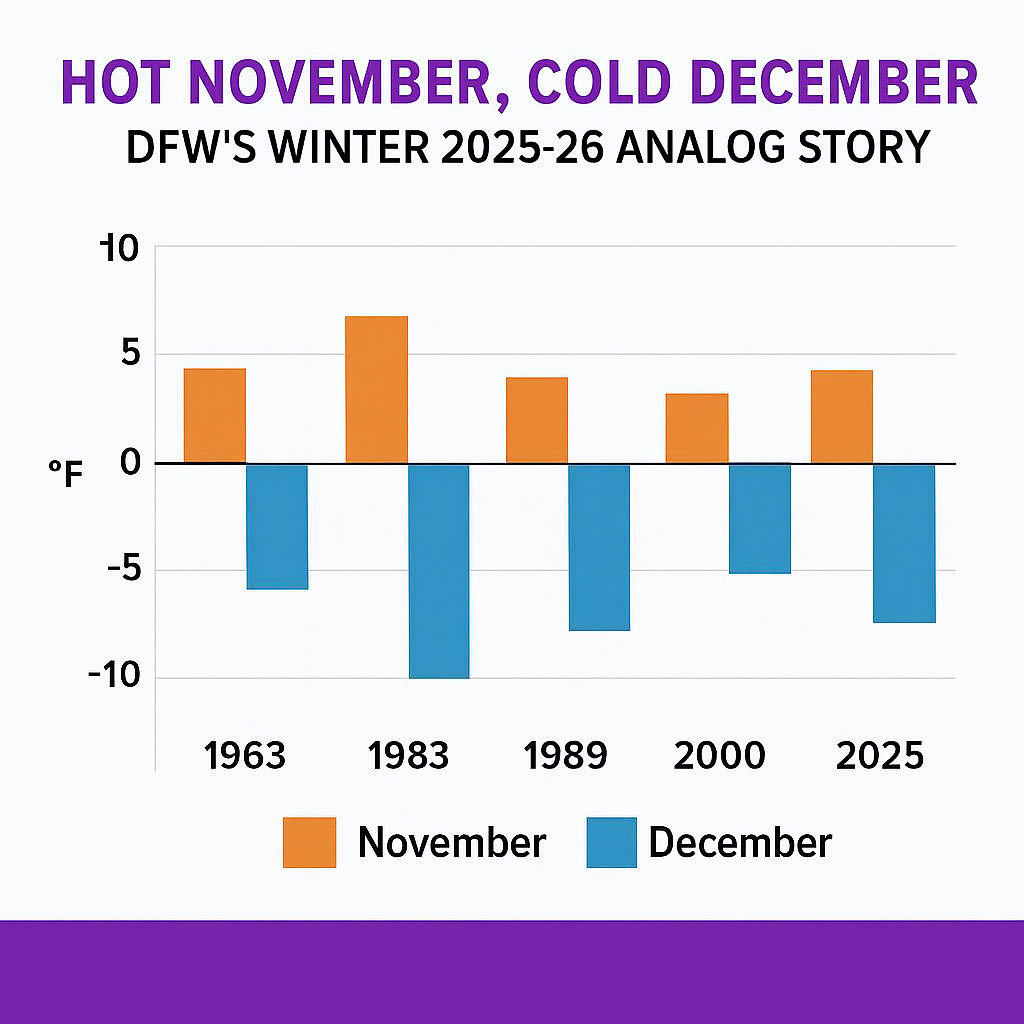
November 2025 has been nothing short of historic in Dallas/Fort Worth. Temperatures have soared to very warm levels, cementing it as the hottest November on record thus far. Several daily temperature records have been broken. But if history is any guide, this kind of extreme warmth rarely lasts. In fact, some of the hottest Novembers in DFW history have been followed by some of the coldest Decembers.

Lessons from the Past

  • 1909: Severely cold December that followed a very warm November. Also a La Niña winter with similar setup to 2025.
  • 1917: Very cold December that was also a La Niña winter that has similar setup to this year that followed a warm November.
  • 1963: November was unusually warm, but December flipped dramatically. Arctic outbreaks brought extended freezes and snow events across Texas.
  • 1983: A warm November gave way to the coldest December ever recorded in DFW. The city endured 295 consecutive hours below freezing, with temperatures averaging nearly 12°F below normal.
  • 1989: A textbook flip—November ran above normal, but December plunged to -9.1°F, delivering DFW’s third coldest temperature on record at -1°F on December 23.
  • 2000: Another warm November preceded the third coldest December on record. Arctic air dominated, and snow fell across much of Texas.

Why the Flip Happens

The atmosphere often seeks balance after extreme anomalies. When November runs hot, December can swing the other way — especially when the large‑scale teleconnections line up. Right now, they do:

Key Current Teleconnection Signals (Late November 2025)

  • Negative PNA: Western troughing favors downstream ridging into the Southeast, opening the door for cold delivery into the Plains.
  • Negative WPO/EPO: High-latitude blocking near Alaska and the Bering Sea reinforces Arctic air displacement.
  • Negative NAO/AO: Greenland blocking and polar pressure anomalies support meridional flow and cold intrusions.
  • MJO Phases 7–8–1: Tropical forcing is entering cold-favorable phases, historically linked to high-latitude blocking and U.S. cold outbreaks 10–20 days later.
  • Stratospheric Warming: A major SSW event is unfolding unusually early, disrupting the polar vortex and increasing the risk of Arctic air spilling southward.

What It Means for December 2025

With November 2025 running hottest on record, the analogs and current teleconnections strongly suggest a high risk of a cold flip. The setup resembles 1963, 1983, and 2000 — years when Texas endured some of its most memorable Arctic outbreaks. December may not be a wall‑to‑wall freeze, but the risk of sharp cold shots is elevated. Expect volatility: warm interludes punctuated by strong Arctic fronts, especially mid-to-late month.

Bottom line: November’s record heat is not sustainable. With the NAO, PNA, WPO, AO, and EPO all trending negative, the Arctic door is opening. History tells us that when DFW runs hottest in November, December can deliver some very cold air. Winter 2025–26 may be setting up to follow that script. Time will tell if the cold comes and if it lasts into much of the winter or retreats. Keep in mind that this is not a forecast, just something that we are monitoring.

FALL 2025: AN EXCEPTIONALLY WARM SEASON FOR DFW

Fall 2025 has been one of the warmest on record for the Dallas/Fort Worth Metroplex, continuing a trend of extended heat and late-arriving cool fronts. With each passing month since September running above normal, the season now ranks as the second warmest fall ever recorded at DFW—coming in just 0.2°F behind the all-time warmest set in 2016.

September: A Hot Start to Fall

September began the season on a warm note. The average temperature for the month was 81°F, which is 2.2°F above normal. The month’s hottest temperature reached 102°F on September 4, while the coolest dipped to 63°F on September 9. Summer heat held on tightly, delaying the arrival of any hint of fall.

October: Fourth Hottest on Record

October 2025 continued the trend with remarkable warmth. The month ended with an average temperature of 74°F—an impressive 5.5°F above normal—ranking it as the fourth hottest October ever observed at DFW.

The hottest temperature occurred on October 7 when the high reached 92°F. A low of 43°F on October 30 provided the only true taste of fall. The month also produced a notable milestone: on October 19, DFW recorded a low of 59°F. This was the latest date on record for the first sub-60°F temperature of the season, highlighting how unusually persistent the warmth has been.

November (to date): Record Heat Holding On

November has offered little relief. So far, the month is running 5.5°F above normal with an average temperature of 65°F. The coldest temperature this fall occurred on November 10 when the low reached 35°F. Just five days later, on November 15, temperatures soared to 89°F—setting a new daily record high.

Forecasts indicate that the record heat is expected to continue through tomorrow, further solidifying this fall’s standing in the climate record books.

Second Warmest Fall on Record

With the continued warmth, Fall 2025 now stands as the second hottest fall ever recorded at DFW. It is trailing the 2016 record by only 0.2°F, underscoring how extreme this season has been.

The prolonged heat has pushed back typical seasonal benchmarks and delivered one of the most unusually warm autumns the region has ever experienced.

DFW WINTER 2025-26 OUTLOOK

Overview
Autumn 2025 has been exceptional across North Texas. As of mid-October, DFW Airport has yet to record a temperature below 60°F — something unprecedented in local climate history. Even if the first sub-60°F low occurs before the end of the month, this will be the latest such occurrence on record by a wide margin.

With September and October both running well above normal, 2025 is shaping up to be among the hottest falls ever observed in the Dallas–Fort Worth area. Historically, every one of the top ten warmest falls at DFW has been followed by a warm winter overall, often featuring mild, dry conditions and only brief cold intrusions.

Historical Context
While most warm falls precede mild winters, there have been exceptions. One notable case was 1963–64, when a very warm October gave way to one of the coldest winters on record for North Texas. This highlights that a warm start to fall doesn’t completely preclude an eventual pattern flip — especially if large-scale oceanic and atmospheric signals favor high-latitude blocking.

Key Climate Signals

  • Pacific Ocean/ENSO: Current projections favor a neutral to weak La Niña for winter 2025–26. Some of the region’s coldest temperatures have occurred during weak La Niña events, but stronger ridging across the southern U.S. tends to dominate if the Pacific pattern remains zonal.
  • North Pacific & Gulf of Alaska: Sea-surface temperatures remain anomalously warm in the Gulf of Alaska. This setup can promote ridging over Alaska, occasionally dislodging Arctic air into the central U.S. if the downstream pattern aligns properly.
  • Stratospheric Conditions: A significant stratospheric warming event over the South Pole in September may have longer-term implications for the global circulation. Historically, such events can sometimes precede a greater likelihood of high-latitude blocking in the Northern Hemisphere later in the season, which can open the door for Arctic outbreaks.

Outlook Summary
Considering the overall pattern, DFW’s winter of 2025–26 appears most likely to be warmer than normal, with limited opportunities for sustained cold. That said, one or two sharp Arctic intrusions cannot be ruled out — especially if the Gulf of Alaska ridge strengthens or the polar jet becomes more amplified later in the season.

In short:

  • Temperature: Above normal overall
  • Precipitation: Near to below normal
  • Cold Outbreak Risk: Low to moderate, mainly mid to late winter